Google Launches GUAC Open Source Project to Secure Software Supply Chain.


Graph for Understanding Artifact Composition

Google on Thursday announced that it's seeking contributors to a new open source initiative called Graph for Understanding Artifact Composition, also known as GUAC, as part of its ongoing efforts to beef up the software supply chain.

"GUAC addresses a need created by the burgeoning efforts across the ecosystem to generate software build, security, and dependency metadata," Brandon Lum, Mihai Maruseac, and Isaac Hepworth of Google said in a post shared with The Hacker News.

"GUAC is meant to democratize the availability of this security information by making it freely accessible and useful for every organization, not just those with enterprise-scale security and IT funding."

Software supply chain has emerged a lucrative attack vector for threat actors, wherein exploiting just one weakness -- as seen in the case of SolarWinds and Log4Shell-- opens a pathway long enough to traverse down the supply chain and steal sensitive data, plant malware, and take control of systems belonging to downstream customers.
Software Supply Chain

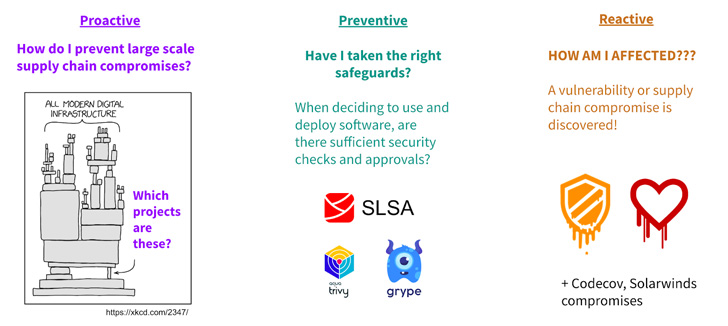
Google, last year, released a framework called SLSA (short for Supply chain Levels for Software Artifacts) that aims to ensure the integrity of software packages and prevent unauthorized modifications.

It has also launched an updated version of Security Scorecards, which identifies the risk third-party dependencies can introduce to a project, allowing developers to make informed decisions about accepting vulnerable code or considering other alternatives.
Software Supply Chain

This past August, Google further introduced a bug bounty program to identify security vulnerabilities spanning a number of projects such as Angular, Bazel, Golang, Protocol Buffers, and Fuchsia.

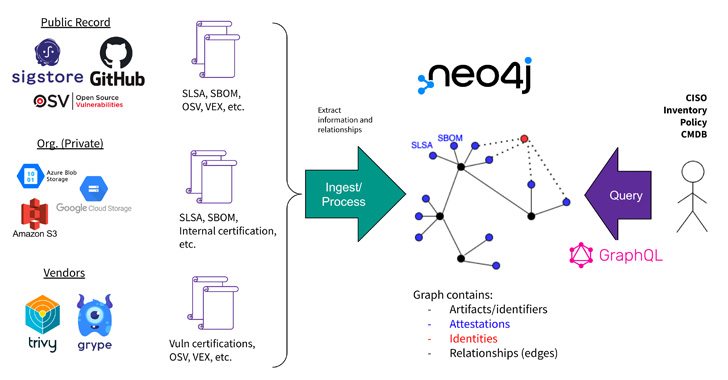
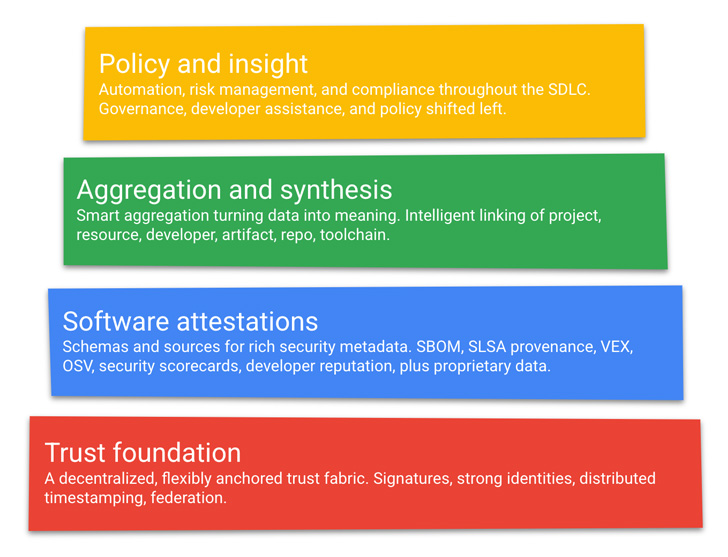
GUAC is the company's latest effort to bolster the health of the supply chain. It achieves this by aggregating software security metadata from a mix of public and private sources into a "knowledge graph" that can answer questions about supply chain risks.

The data that undergirds this architecture is derived from Sigstore, GitHub, Open Source Vulnerabilities (OSV), Grype, and Trivy, among others, to derive meaningful relationships between vulnerabilities, projects, resources, developers, artifacts, and repositories.

"Querying this graph can drive higher-level organizational outcomes such as audit, policy, risk management, and even developer assistance," Google said.

Put differently, the idea is to connect the different dots between a project and its developer, a vulnerability and the corresponding software version, and the artifact and the source repository it belongs to.

The aim, therefore, is to not only enable organizations to determine if they are affected by a specific vulnerability, but also estimate the blast radius should the supply chain be compromised.

That said, Google also appears to be cognizant of the potential threats that could undermine GUAC, including scenarios where the system is tricked into ingesting forged information about artifacts and their metadata, which it expects to mitigate through cryptographic verification of data documents.

"[GUAC] aims to satisfy the use case of being a monitor for public supply chain and security documents as well as for internal use by organizations to query information about artifacts that they use," the internet giant noted.

Comments

Popular posts from this blog

UGANDA ELECTORAL COMMISSION TO ELIMINATE NATIONAL IDENTIFICATION CARDS (IDs) FOR 2021 GENERAL ELECTIONS.

The elimination of using National IDs (Ndagamuntu) for the 2021 elections should not have come as a surprise. One would be very NAIVE to think that Bobi Wine has not prepared for this in his Business Plan under the RISK section. It is public knowledge that our EC is not independent.  It is also public knowledge that Military Dictator Yoweri Museveni will never lose an election. What stunned us this morning is when we noticed that on social media, people were mocking Bobi with his "get your Ndagamuntu".  We are on record for saying to all Our readers that the National ID is like Apartheid in South Africa. Students of History would know how those IDs were being used to arrest people, deny them jobs, deny them basic services. Consequently, Bobi was not wrong and will never be wrong on the Ndagamuntu. Except the ones attacking him and mocking him forget that in Uganda, now, no National ID (Ndagamuntu), no service.  If you have not been denied registering your child i...

Parliament Urges Government to Provide Shs 4 Billion to Media Houses to Run Awareness Campaign on Tourism in Uganda.

Parliament also urged Gov’t to provide additional Shs4Bn to UTB to engage international and national media houses in production of positive media stories for improved destination image, following reports of drop in number of tourists from US, Europe and China visiting Uganda. "The National Development Plan targeted to cumulatively attract 281,760 International Tourist arrivals from US, Europe & China but only 67,252 arrivals were registered by the end of the first half of FY 2023/24. The U.S, Europe & China were key target source for leisure tourist who stay longer than business tourists. However, statistics show that international arrivals from the aforementioned areas have continue to drop. The UTB requires Shs4Bn to engage international & national media houses in production of positive tourism stories to improve destination perception in light of recent controversies that shade the destination in a bad light. However, this has remained unfunded,” said La...

UPDF has Rehabilitated Boreholes and Shallow Wells in Maracha District Ahead of 45th Tarehe Sita.

Story by Osuta Yusuf. Maracha District.  30-12-2025. 📸: The technical team fixing some of the  boreholes. Photo by Osuta Yusuf, Our News Reporter. The Uganda Peoples Defence Forces (UPDF) which is the legally constituted security organ to guard and protect the people, properties and sovereignty of Uganda, have rehabilitated a total of 9 Boreholes and shallow wells at the tune of 15m Shs in 7 Sub-counties out of the 19 Sub-counties in Maracha District through a service dubbed under the Theme of “QUICK IMPACT PROJECT” directly financed by the UPDF, ahead of preparation for the celebration of their next year's 2026 Tarehe Sita anniversary. 📸: Official launch of UPDF’s 45th Tarehe Sita celebration ahead of the due date 6-February-2026. Courtesy Photo. The UPDF Tarehe Sita is an annual public holiday and event that takes place on every 6th of February, the date when the then Uganda Patriotic Movement (UPM) party now turned as National Resistance Army / Movement (NRA / M) headed b...